

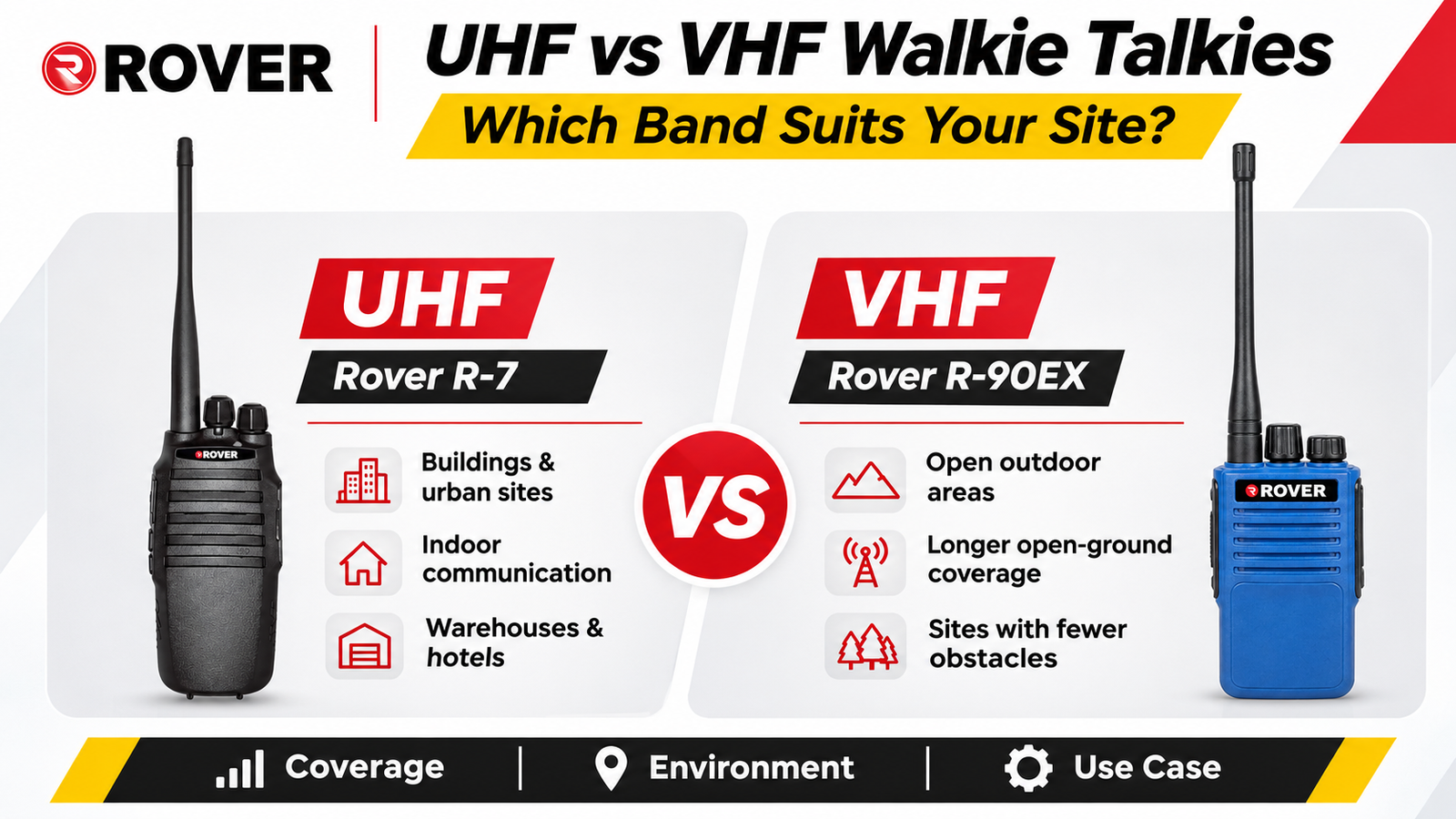
UHF vs VHF: UHF usually suits buildings and urban sites, while VHF often suits open outdoor areas. Neither band is universally better. The right choice for your UAE business depends on the terrain, building materials, antenna setup, permitted frequencies and where your teams need to communicate.
A security manager in a Dubai tower has different coverage needs from a supervisor on an open desert construction site. This guide compares the two bands and explains how to select a suitable radio system without relying on advertised distances alone.
VHF stands for Very High Frequency and covers the general radio spectrum from 30 to 300 MHz. UHF stands for Ultra High Frequency and covers 300 MHz to 3 GHz. Professional handheld radios use only specific portions of these broad bands. These definitions are not lists of frequencies available for business use in the UAE.
The main physical difference is wavelength. VHF signals have longer wavelengths than UHF signals. This affects antenna design, diffraction around obstacles and the way radio waves interact with buildings and terrain.
A higher frequency does not automatically mean a stronger signal. Likewise, a lower frequency does not guarantee greater coverage. The complete radio system, including its antenna, receiver and installation environment, determines whether staff can exchange clear messages.
UHF is commonly selected for commercial buildings and dense urban environments. Its shorter wavelength allows relatively compact antennas and can be advantageous for communication through complex indoor spaces, around openings and among reflecting surfaces.
If you are selecting a UHF radio for buildings, consider shopping malls, hotels, hospitals, office towers and warehouses. These locations often combine multiple floors, corridors, partitions and moving staff. A compact handheld is also convenient for employees who carry a radio throughout their shift.
However, UHF does not always penetrate concrete better than VHF. Reinforcement, wall thickness, metal cladding and the position of the antenna can significantly affect either band. A basement or lift may remain difficult to reach even when other areas have good reception.
Ask your supplier to test calls from loading bays, stairwells, plant rooms and other critical points. Do not judge a whole property from a successful call in its reception area.
VHF is often a practical option where teams work across relatively open land. Its longer wavelength can help with propagation around some terrain features, and under comparable conditions it may offer an advantage over higher frequencies across open ground.
Desert operations, farms and open construction sites are useful examples when evaluating a VHF radio outdoor solution. Consider antenna height, vehicle movements and whether staff will be separated by dunes, hills or temporary buildings.
Marine communication also commonly uses VHF, but marine channels and equipment have specific operational and regulatory requirements. A general-purpose business radio should not be treated as a substitute for an appropriately authorised marine radio.
An outdoor site is not necessarily an open site. A construction project with steel structures, concrete cores and enclosed workspaces may benefit from UHF or a repeater system instead. Repeat the assessment as construction progresses.
| Factor | UHF | VHF |
|---|---|---|
| General frequency range | 300 MHz–3 GHz | 30–300 MHz |
| Building penetration | Often practical in complex indoor environments; material dependent | Can work indoors; material and layout dependent |
| Open-area range | Can perform well with suitable antennas and clear paths | Often advantageous over open ground under comparable conditions |
| Antenna size | Typically shorter for comparable antenna designs | Typically longer for comparable antenna designs |
| Typical users | Security, hospitality, facilities, warehouses | Agriculture, open-site operations and authorised marine users |
| Best for | Buildings, urban sites and mixed indoor/outdoor premises | Relatively open outdoor terrain |
When asking ‘UHF or VHF which is better?’, use the table as a starting point rather than a fixed rule. Local interference, antenna quality and the location of the people using the radios can change the outcome.
Advertised radio range is often based on favourable conditions. Real workplaces introduce obstacles that absorb, reflect or block signals. Two radios that communicate across a clear outdoor area may struggle between underground parking and an upper floor.
Antenna height is particularly important. Raising a properly installed antenna can improve the radio path, while a handheld worn close to the body may perform differently from one held upright in the open. Terrain and surrounding structures can also create coverage shadows.
Transmitter power is another factor, but more watts alone cannot guarantee reliable two-way communication. The receiving radio must hear the signal clearly, and the return transmission must also reach its destination. Higher power may increase battery use and must comply with authorised operating conditions.
For large campuses or persistent dead zones, a compatible repeater may be appropriate. A repeater receives and retransmits radio signals from a planned location, often with a better antenna position. Its effectiveness depends on system design, permitted frequencies and installation.
During a site trial, test calls in both directions under normal operating conditions. Include busy periods, closed doors and the locations where missed messages would cause the greatest disruption. Record failures and use the results to decide whether another band, antenna arrangement or repeater is needed.
A dual band walkie talkie supports frequencies in both VHF and UHF. This can be helpful for contractors who move between different sites or organisations that need to communicate with more than one compatible radio fleet.
Dual-band capability does not automatically improve range. Each transmission still takes place on a particular frequency, and the antenna and radio configuration must suit that band. Check the specific radio’s operating modes and compatibility before buying.
For a team working entirely within one building, a straightforward single-band radio may be easier to manage. For mixed environments, dual-band equipment can provide flexibility, provided the organisation is authorised to use the relevant channels.
A UHF-only radio and a VHF-only radio cannot communicate directly if they operate on different bands. Matching channel numbers on their displays does not mean their actual frequencies are the same.
A compatible dual-band radio can communicate with a single-band radio by selecting the corresponding authorised frequency and matching its operating mode and other required settings. Analogue and digital modes must also be compatible.
Connecting users on different bands simultaneously requires a suitable cross-band repeater or engineered gateway. Not every dual-band handheld provides this functionality. Ask a qualified supplier to design and configure any bridging solution rather than assuming it is built into the radio.
The Telecommunications and Digital Government Regulatory Authority (TDRA) oversees radio spectrum and telecommunications equipment in the UAE. Its Private Mobile Radio service provides information about applying for spectrum authorisation.
Equipment type approval and authority to transmit on particular frequencies are distinct. A radio’s technical tuning range is not permission to use every frequency within it. TDRA’s equipment registration and approval service explains the equipment approval process.
Before ordering a fleet, confirm the model’s approval documentation and whether your planned frequencies, power and repeater arrangements require authorisation. If you are unsure, check with TDRA or your supplier before operating the equipment.
Use the following shortlist to compare models for your site. These are product specifications, not guarantees of coverage or permission to operate at the listed maximum output power.
| Use case to assess | Rover model | Listed specifications |
|---|---|---|
| Indoor security and facilities | Rover R-8 | UHF, 400–480 MHz, 2 W, 128 channels, TDRA approved |
| Higher-power UHF evaluation | Rover R-7 | UHF, 10 W |
| UHF business operations | Rover R-20 | UHF, 5 W |
| Wet or mixed environments | Rover R-5WP | VHF/UHF dual band, 10 W, waterproof |
| Mixed-band coverage assessment | Rover RO-30UV | VHF/UHF dual band, 10 W, long-range model |
| Mixed-band sites needing location features | Rover R-15GPS | VHF/UHF dual band, 15 W; confirm GPS configuration |
| Compatible DMR coverage expansion | Rover R-5000D | Digital DMR repeater for extending coverage |
Explore the Rover radio range and read our professional walkie talkie buying guide for advice on battery life, durability and accessories.
UHF is typically a good starting point for buildings and dense urban sites. Reinforced concrete, metal structures and underground rooms can still cause dead zones, so test coverage before ordering.
VHF may have an advantage over open ground when other conditions are comparable. Actual walkie talkie range depends on antennas, terrain, power, interference and receiver performance.
Yes, UHF can work well outdoors, particularly where teams move between buildings and open areas. Use authorised frequencies and test the specific locations where communication is needed.
Single-band UHF and VHF radios cannot communicate directly on different bands. A compatible dual-band radio operating on the same channel, or a correctly engineered cross-band system, can provide a solution.
It is a radio capable of operating on supported frequencies in two bands, commonly VHF and UHF. It does not automatically relay between bands or grant permission to use every available frequency.
The UHF vs VHF decision should begin with your coverage needs, not the highest power rating. Shortlist radios for the actual environment, confirm UAE operating requirements and arrange a practical site test. To discuss your project or request a quotation, contact Rover or WhatsApp +971 50 770 3906.

One Response